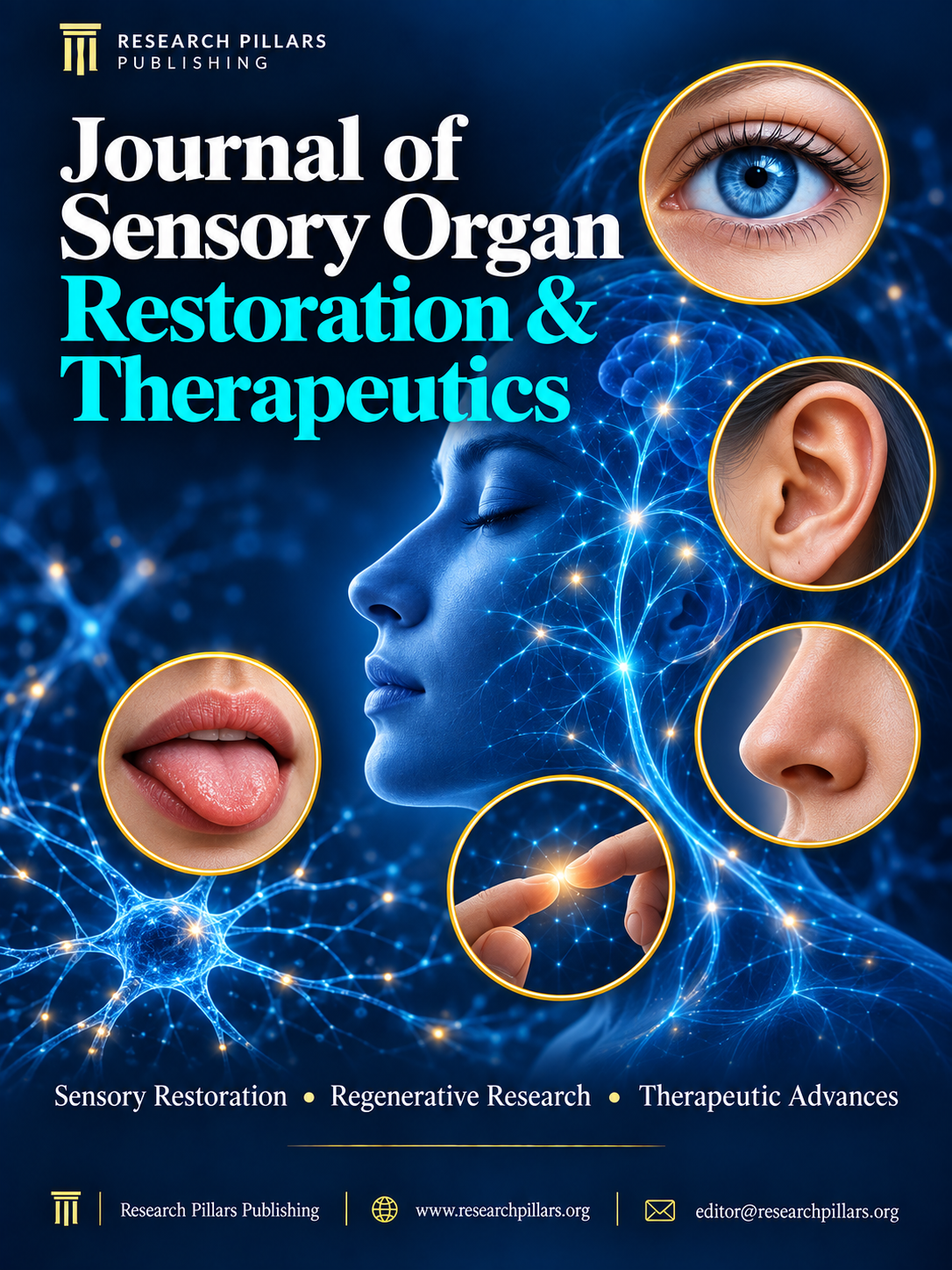
Journal of Sensory Organ Restoration & Therapeutics
Aims & scope
Aim
The Journal of Sensory Organ Restoration and Therapeutics aims to advance scientific knowledge and clinical practice in the prevention, diagnosis, treatment, and restoration of disorders affecting the human sensory systems. The journal provides an interdisciplinary platform for research addressing the structural and functional integrity of sensory organs, the mechanisms underlying sensory impairment, and the development of therapeutic approaches that preserve, repair, or recover sensory function.
Particular emphasis is placed on advances in ophthalmology, auditory and vestibular medicine, olfactory and gustatory sciences, and somatosensory research, including the neural pathways responsible for processing sensory information. The journal encourages investigations spanning molecular and cellular mechanisms, regenerative medicine, neuroplasticity, biomaterials, biomedical engineering, assistive technologies, and innovative therapeutic interventions.
Through the integration of basic science, translational investigation, and clinical research, the journal seeks to strengthen the evidence supporting emerging restorative treatments and improve understanding of their safety, efficacy, and functional outcomes. It welcomes contributions that address established clinical challenges as well as emerging approaches to sensory recovery, with the broader objective of improving patient function, independence, and quality of life.
Scope
The journal welcomes original research articles, systematic reviews, meta-analyses, clinical studies, methodological contributions, and other scholarly work addressing sensory organ biology, dysfunction, restoration, and therapeutic development. Areas of interest include, but are not limited to, the following:
1. Sensory Organ Biology and Pathophysiology
Research on the development, structure, physiology, and function of sensory organs, together with the cellular, molecular, genetic, and pathological mechanisms underlying sensory impairment, degeneration, injury, and loss of function.
2. Ophthalmic Restoration and Visual Rehabilitation
Studies involving retinal degeneration, corneal repair, optic nerve injury, visual pathway disorders, retinal regeneration, ocular tissue engineering, visual prostheses, and therapeutic approaches aimed at preserving or recovering visual function.
3. Auditory and Vestibular Restoration
Research addressing hearing loss, cochlear injury, hair-cell regeneration, auditory neuropathy, vestibular dysfunction, balance disorders, cochlear implants, auditory brainstem implants, and emerging interventions for restoring hearing and vestibular function.
4. Olfactory and Gustatory Function
Investigations into disorders of smell and taste, sensory receptor biology, olfactory and gustatory nerve injury, regeneration of sensory epithelium, diagnostic assessment, and therapeutic strategies for recovering chemosensory function.
5. Somatosensory Function and Neural Repair
Studies of touch, temperature perception, proprioception, pain-related sensory dysfunction, peripheral sensory nerve injury, nerve regeneration, sensory neuropathies, and interventions designed to improve somatosensory function.
6. Regenerative Medicine and Tissue Engineering
Research on stem-cell-based approaches, cellular therapies, tissue engineering, biomaterials, scaffolds, organoids, biofabrication, and regenerative strategies for repairing or replacing damaged sensory tissues. Studies should address the biological rationale, translational potential, and relevant safety considerations of proposed interventions.
7. Sensory Neuroscience and Neuroplasticity
Investigations into sensory neural circuits, neuronal survival, synaptic plasticity, central sensory processing, neural adaptation, and mechanisms of functional recovery following sensory deprivation, injury, or therapeutic intervention.
8. Therapeutic Development and Clinical Interventions
Preclinical and clinical research on pharmacological agents, biological therapies, surgical procedures, gene-based interventions, molecular treatments, and other emerging approaches for preventing sensory degeneration, limiting tissue damage, or restoring sensory function.
9. Biomedical Engineering and Sensory Prosthetics
Advances in cochlear and retinal implants, neural interfaces, sensory substitution devices, neuroprosthetics, assistive technologies, artificial sensory systems, and rehabilitation devices designed to compensate for or restore impaired sensory capabilities.
10. Diagnostic Technologies and Functional Assessment
Research on imaging, electrophysiology, molecular diagnostics, sensory testing, biomarkers, quantitative functional assessment, and emerging technologies for detecting sensory dysfunction, monitoring disease progression, and evaluating treatment outcomes.
11. Rehabilitation and Functional Recovery
Studies examining sensory rehabilitation, neurorehabilitation, adaptive training, multisensory integration, compensatory strategies, patient-centred interventions, and functional outcomes following sensory injury or treatment.
12. Translational Research and Clinical Outcomes
Preclinical validation, clinical trials, longitudinal studies, comparative effectiveness research, and real-world evaluations of sensory restoration technologies. Relevant outcomes include functional improvement, durability of treatment response, safety, adverse events, patient-reported outcomes, accessibility, and quality of life.
Article Types
The journal considers original research articles, systematic reviews, meta-analyses, narrative reviews, brief communications, methodological studies, clinical and translational investigations, and perspectives relevant to its aims and scope. Case reports and case series may be considered when they provide substantial clinical, mechanistic, or therapeutic insight into sensory disorders or restoration.
Keywords
Sensory organ restoration; Sensory disorders; Regenerative medicine; Sensory neuroscience; Ophthalmic regeneration; Hearing restoration; Vestibular rehabilitation; Olfactory dysfunction; Gustatory disorders; Peripheral nerve regeneration; Neuroplasticity; Tissue engineering; Sensory prosthetics; Biomedical engineering; Sensory rehabilitation
The journal prioritizes scientifically rigorous research that advances understanding or treatment of sensory dysfunction and demonstrates a clear contribution to the field. Submissions should employ appropriate study designs, validated outcome measures, transparent reporting, and conclusions proportionate to the evidence presented. Both positive and negative findings are welcome when they provide meaningful insight into therapeutic effectiveness, biological mechanisms, or the limitations of emerging restorative approaches.
The journal encourages collaboration among clinicians, neuroscientists, regenerative medicine researchers, biomedical engineers, and allied health professionals to support the responsible development and evaluation of interventions for sensory impairment.
Latest publications
No published articles yet
New research will appear here as issues are published.